Knowing how to check a contractor matters most at the moment you are least inclined to do it. The roof is leaking, the kitchen has been a dream for years, or a friendly stranger at the door says your driveway needs attention today. A home project can be one of the largest checks a household writes, and the person cashing it is often someone you met last week.
Most contractors are honest people doing hard work. The difficulty is that a capable tradesperson and a careless one can look identical in a phone call, and a scammer may be the most polished of the three. Star ratings help, but they cannot tell you whether a license is active or whether a worker injured on your property is covered by insurance.
We should say where we stand. American Business Recognition publishes this blog and scores US businesses from public Google ratings. A recognition from ABR, or from anyone else, says something about customer satisfaction. It is not a license check, an insurance check or a guarantee of workmanship.
Our position is that about an hour of checking can screen out most of the serious risk before any money moves. The steps below rely on public records and on advice from the Federal Trade Commission and state regulators. You do not need to know anything about construction to follow them.
Why Home Projects Attract Trouble
Home repair combines several conditions that bad actors like. Jobs are expensive and infrequent, so most homeowners have little experience buying them. Payment often comes before the work is finished. Problems can stay hidden behind a wall for years. And after a storm or a sudden failure, people make decisions under stress.
The FTC's guidance on home improvement scams lists the warning signs it sees repeatedly. A contractor knocks on your door and says they are working in the area. They have materials left over from another job. They press you to decide right now. They want full payment up front or will only take cash. They ask you to get the building permits yourself. They suggest borrowing from a lender they happen to know.
None of these proves fraud on its own. A legitimate company can canvass a neighborhood. Taken together, though, they describe a transaction in which you carry nearly all of the risk.
It also helps to know that rules differ from place to place. Licensing is largely handled by states, and sometimes by counties or cities, so a trade that requires a state license in one place may need only local registration in another. The National Association of State Contractors Licensing Agencies, known as NASCLA, says its licensee database is available only to member states, so there is no single national lookup for homeowners. Your search has to happen at the state or local level.
Verify the License at the Source
Ask for the contractor's license number and the exact business name on the license. Then look it up yourself on the website of your state's licensing board or your county's licensing office. The FTC advises confirming the license with your state or county government, and that is the check to rely on. A number printed on a truck or a website is only a claim.
California gives a good example of what such a tool looks like. The Contractors State License Board offers a public license search that homeowners can use for free. Many other states run something similar, although the available detail varies.
When you find the record, check these points.
- Status. The license should be active, not expired or suspended.
- Name. It should match the company on your estimate and contract.
- Classification. The license should cover the kind of work you are hiring for.
- History. Where the board publishes complaints or disciplinary actions, read them.
Be careful with third-party "license lookup" sites, which may be out of date. Use them only to find your way to the official board.
If your state does not license a particular trade, or the job is small, the absence of a license may be normal. California, for instance, raised its exemption for small handyperson jobs to under $1,000 in 2025, with all costs counted. Check the rule that applies to you. If someone needs a license for the job and will not give you the number, stop there.
Confirm Insurance and Who Pays for Accidents
The FTC tells homeowners to ask for proof of insurance. Two kinds usually matter. General liability covers damage the contractor causes to your property. Workers' compensation covers injuries to the crew. Rules on workers' compensation vary by state and company size, so ask what applies to the firm you are considering.
Why should this concern you? If an uninsured worker is hurt on your property, or a fire starts during the job, you could be left arguing over who pays. Your homeowner's insurer can explain how your own policy would respond, and a short call before the project starts is worthwhile.
A certificate of insurance is easy to request, and it is also easy to fake or to hand over after a policy has lapsed. Our suggestion is to ask for a current certificate, note the name of the insurer and the policy number, and call the insurer or agent listed to confirm that the coverage is active. Ask whether the policy matches the type of work being done. For a large project, ask to have the certificate sent directly from the agent.
Check on subcontractors too. Ask who will actually be doing the work at your home and whether those people are covered.
Read Reviews and References for Patterns
Reviews can tell you things a license record cannot, such as whether the crew shows up on time or the company answers the phone after the final payment. Read them for specifics. Look for your kind of project, for recent dates, and for how the owner responds when something goes wrong. A rating of 4.6 from hundreds of customers generally tells you more than a perfect score from six. Our guide on what makes a good Google rating explains why, and this checklist can help you notice suspicious patterns.
The FTC also suggests searching the company's name along with words such as "scam," "review" or "complaint." Add the owner's name to that search. If a business has changed its name several times in a few years, ask why.
References are worth the effort, provided you ask real questions. A contractor will naturally give you names of happy customers, so focus on detail.
- What was the original price and the final price?
- Did the job finish when promised? What caused any delay?
- Who was on site each day, and how did they treat the house?
- Did anything go wrong later, and how was it handled?
- Would you hire them again for a larger project?
If possible, ask to see a finished job similar to yours. Ten minutes in front of real tile or a real deck can tell you more than any brochure.
Your local Home Builders Association and consumer protection office are two more places the FTC suggests checking for complaints. A quiet record is not proof of quality, but a pattern of unresolved complaints is useful to know about.
Compare Written Estimates the Right Way
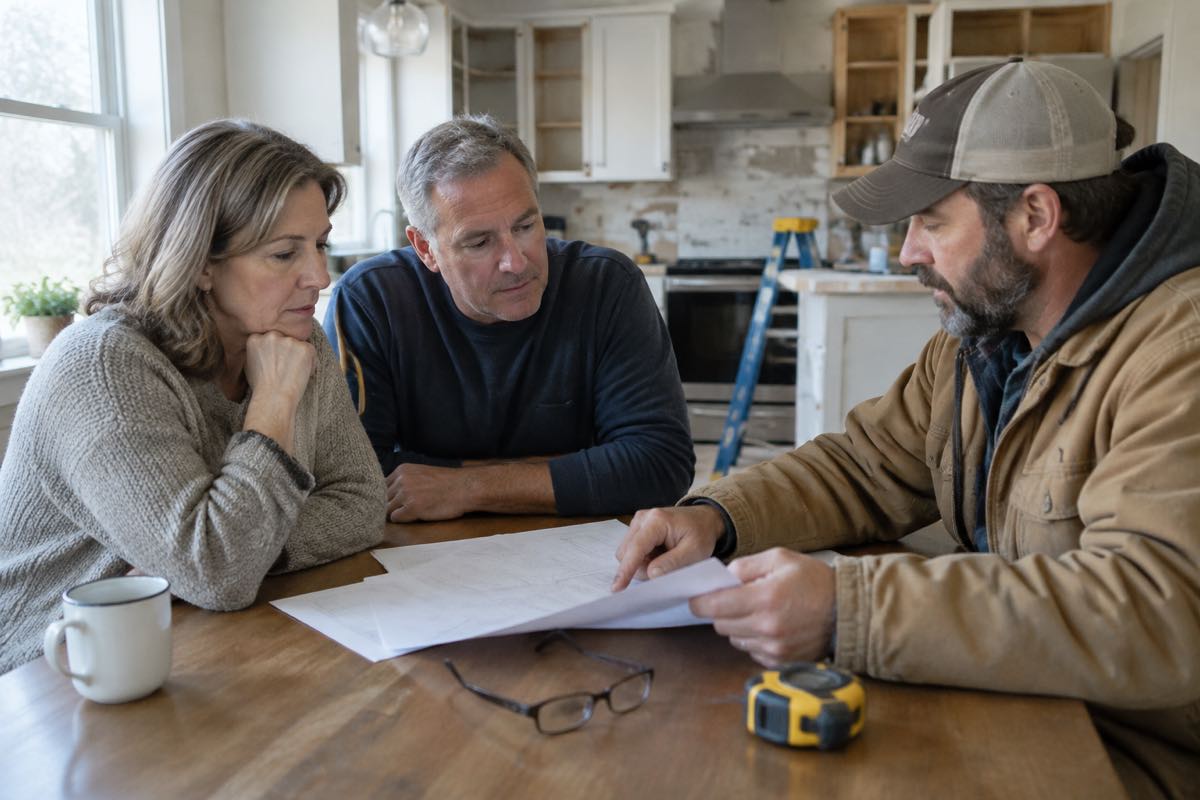
Get several written estimates. The FTC says each should describe the work, the materials, the completion date and the price. A verbal figure given on the driveway cannot be compared with anything.
Do not automatically choose the lowest bid. The FTC advises asking for an explanation when prices differ widely. A low number may reflect cheaper materials, a smaller scope, no permit or an expectation of change orders later. A high number may reflect better work or simply a busy company. Lay the estimates side by side and go through them line by line, then ask each contractor to explain anything the others included and they did not.
Ask about permits at this stage. In most cases the person doing the work should know what is required and handle it, which is why the FTC lists asking you to pull permits as a warning sign. Permits bring an inspection, and that gives you an outside check on the work.
If you need a similar method for vehicle repairs, our guide on choosing an auto repair shop follows the same logic of written estimates and explained differences.
Protect Your Money and Read the Contract
A good contract is your strongest protection. The FTC recommends a written contract even where your state does not require one. It should include the contractor's name, address, phone number and license number, the estimated start and completion dates, and any verbal promises about scope, labor or materials. No space should be left blank when you sign.
Payment needs the same care. Do not pay the full amount up front. Some states limit deposits, so ask your state or local consumer agency. In California, the state board's homeowner checklist says a down payment should be no more than 10% of the contract price or $1,000, whichever is less. Payments after that should follow completed stages of the work.
The way you pay matters too. The FTC's home repair scams page warns against wire transfers, gift cards, payment apps, cryptocurrency and cash, because money sent that way is very hard to recover. A credit card or check leaves a record. Keep the final payment back until the work is finished and you are satisfied.
Liens are the risk few homeowners know about. If your contractor fails to pay a supplier or subcontractor, that party may be able to file a claim against your home, even though you paid in full. The FTC suggests asking for lien releases or waivers from the contractor, subcontractors and suppliers before the final payment. On a large job, make this a stated condition of the contract.
You may also have time to change your mind. The FTC's Cooling-Off Rule lets you cancel certain sales made at your home for a full refund until midnight of the third business day after the sale. It applies to home sales of $25 or more and to sales at temporary locations of $130 or more. There are exceptions, including sales needed to meet an emergency and repairs you asked the seller to come out and make, so read the terms before relying on it.
A One-Hour Check Before You Sign
Here is the whole process in the order we would follow it. Most of it can be done from a phone.
- Get the details. Ask for the full legal business name, license number, address and insurer.
- Look up the license. Use the official state or county site and confirm the status, name and classification.
- Call the insurer. Confirm that the coverage is current and fits the job.
- Search the name. Read reviews and add "complaint" and "scam" to your search.
- Phone two references. Ask about final price, schedule and problems afterward.
- Compare estimates. Collect several in writing and get large differences explained.
- Read the contract. Check for dates, license number and promises, and leave no blanks.
- Plan the payments. Limit the deposit, tie later payments to stages of work and hold back the last one.
Pressure is a useful test throughout. A reputable contractor will expect these questions, since careful customers tend to be good customers. If someone reacts badly to a request for a license number, you have learned what you needed to know.
Should something go wrong, the FTC suggests trying to resolve it with the contractor first and following up by certified mail with a return receipt. Keep copies of everything. If that fails, contact your state attorney general or local consumer protection office.
Where Contractor Checks Are Heading
Fake credentials and fake reviews are becoming cheaper to produce. Software can generate a convincing website, a professional-looking certificate and a stream of plausible praise in very little time. That makes the official record more important, since a state license database is much harder to imitate than a marketing page.
Scammers also tend to follow disasters. The FTC publishes specific warnings for weather emergencies, when damaged homes and insurance payouts bring out-of-town crews to affected neighborhoods. If your area has just had a storm, slow down and apply each check, even though the urge to act quickly will be strong.
Customers are also beginning to use AI assistants to shortlist local tradespeople. A suggestion from an assistant is a starting point at best. It may be drawing on outdated pages, and it cannot confirm that a license is active today. The final check still belongs to you and the official source.
The Checks That Protect Your Home
Hiring a contractor does not have to feel like a gamble. The most useful checks are also simple. Confirm the license at the source, verify the insurance, look for patterns in reviews, and speak to real former customers. Then compare written estimates and sign a complete contract that keeps enough of your money back to matter.
Ratings and awards have a place in that process, including ours. They can help you build a shortlist of businesses that customers have been happy with. They cannot replace a license lookup or a call to an insurer, and any business that presents a badge as if it were a credential is asking you to skip the step that protects you.
Remember the central idea from the start of this guide. An hour of checking costs very little compared with a failed roof or a lost deposit, and honest contractors will not object to it.
Start with the license number. If the contractor gives it readily and the record matches, you are off to a good start. You can also browse recognized businesses by state or read how the ABR score works so you know exactly what it measures and what it leaves out.
Questions About Checking a Contractor
How do I look up a contractor's license?
Use the website of your state licensing board, or your county or city licensing office where the trade is licensed locally. Search by license number or business name. Confirm the status, the name and that the classification fits your job.
Is there a national contractor license database?
Not one that homeowners can use. NASCLA's database is limited to its member states and is not released to the public. Licensing is handled at state or local level, so go to the official agency where the work will happen.
How much should I pay a contractor up front?
Pay as little as is reasonable, and never the full amount. Some states set a limit. California caps a home improvement down payment at 10% of the contract price or $1,000, whichever is less. Ask your state or local consumer agency about your rules.
Can I cancel a contract I signed at home?
Often, but not always. The FTC's Cooling-Off Rule gives you until midnight of the third business day for many sales made at your home. Emergency work and repairs you requested may be excluded. Your contract should include a notice of your right to cancel when the rule applies.
What is a lien release?
It is a document in which a contractor, subcontractor or supplier gives up the right to file a claim against your home for payment. Ask for these before your final payment, since an unpaid supplier could otherwise pursue a claim even after you have paid the contractor.
Is a contractor with great reviews safe to hire?
Reviews are useful evidence about customer experience, but they do not confirm a license or insurance. A contractor can be well reviewed and still have a lapsed policy. Do the record checks as well.
Does an award mean a contractor is licensed?
No. An award from ABR reflects public customer ratings. It does not verify licensing, insurance or the quality of a specific job. Check those directly with the official sources.
This article is general information and is not legal advice.